Posts

Showing posts with the label agile

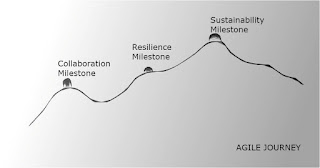
The Resilience Milestone
Image
At first sight, resilience appears to be about: the capacity to recover quickly from difficulties; toughness the ability of a substance or object to spring back into shape; elasticity To use a boxing analogy, the definition of resilience appears to suggest that the organization gets hit, goes down for the count, then manages to get up at the count of eight and get back into the fight. Is it just that?  From all literature, it appears that this is the most common understanding. It is also most visible in IT strategy where a lot of investment dollars are spent in securing business continuity in case of a disaster. We live in an era where complexity and ambiguity is the norm. Globalization, new technologies, and greater transparency have combined to upend the business environment and give many CEOs a deep sense of unease. Since 1980 the volatility of business operating margins, largely static since the 1950s, has more than doubled, as has the size of the gap between ...
The operating model

Image
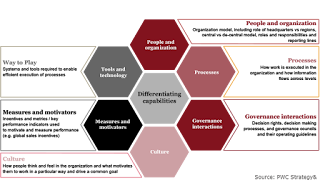
An "operating model" is how a company organizes and manages its resources to achieve its strategic vision. It is the bridge between strategy and execution. So the manner in which a company creates or updates its operating model to match changes in strategy is a crucial question for transformation programs. A sample operating model blueprint Source: PWC Strategy& Operating model serves as a bridge connecting strategy and execution Source: bain.com Structure - the company's organization chart, if you will - is primarily about accountabilities. Especially as companies transition to agile, they must learn to balance this accountability with increased autonomy. The new operating model also requires a governance structure and leadership model so leaders know how they will exercise operational control and inspire employees. Ikea anchors its cost leadership position on several differentiated capabilities Source: bain.com Operating models involve everyt...